Sensor BMP180 de temperatura e pressão barométrica para Arduino
O sensor BMP180 é um dispositivo versátil que mede temperatura e pressão barométrica, tornando-o ideal para várias aplicações, como monitoramento meteorológico e medição de altitude. Neste tutorial, vamos conectar o sensor BMP180 a um Arduino, ler dados de temperatura e pressão e exibir os resultados. Ao final deste projeto, você poderá obter leituras de temperatura precisas em Celsius e Fahrenheit, assim como valores de pressão em milibares e polegadas de mercúrio.

Para esclarecer os conceitos e as etapas de codificação, recomendo que você assista ao vídeo associado para explicações detalhadas (no vídeo em 00:00).
Hardware Explicado
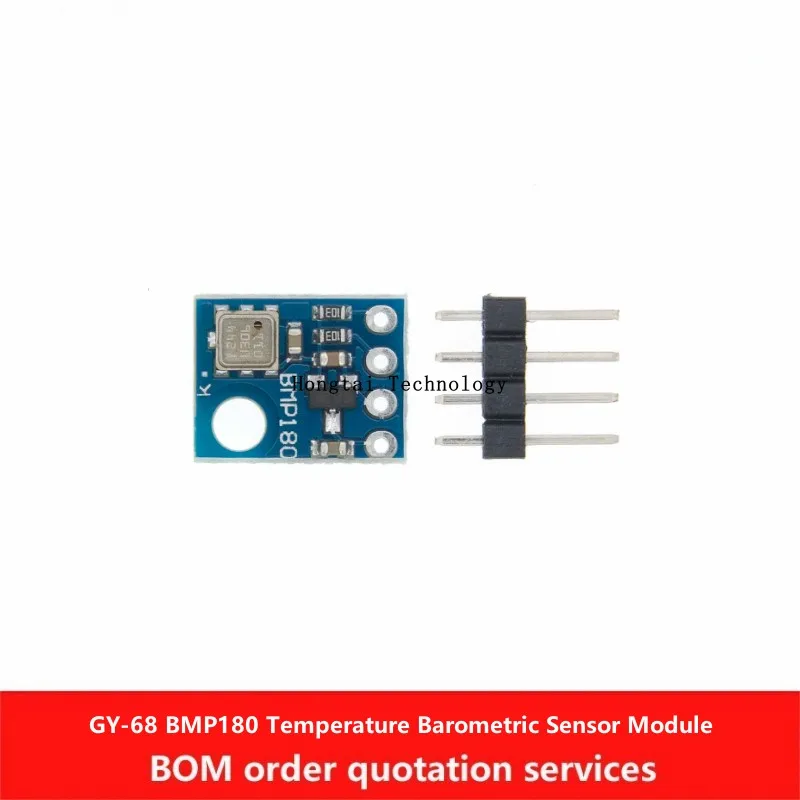
O BMP180 é um sensor digital que se comunica via I2C, o que permite que ele se conecte facilmente a microcontroladores como o Arduino. Ele possui quatro pinos:Vn(fonte de alimentação),GND(solo),SDA(linha de dados), eSCL(linha de clock). O sensor opera numa faixa de tensão de 1,8 a 3,6 V, mas pode ser alimentado por uma fonte regulada de 5 V usando um regulador de tensão.
A capacidade deste sensor de medir a pressão atmosférica o torna adequado para aplicações que exigem estimativa de altitude e monitoramento meteorológico. O BMP180 também inclui um sensor de temperatura integrado, o que é essencial para obter leituras de pressão precisas. Ao medir a temperatura primeiro, o sensor pode compensar as variações de temperatura que afetam as leituras de pressão.
Detalhes da ficha técnica
| Fabricante | Bosch |
|---|---|
| Número da peça | BMP180 |
| Tensão lógica/E/S | 1.8 - 3.6 V |
| Tensão de alimentação | 1.8 - 5.0 V |
| Corrente de saída (típ.) | 5 μA |
| Corrente de pico (máx.) | 1 mA |
| Orientação sobre a frequência PWM | Não aplicável |
| Limiares lógicos de entrada | Não aplicável |
| Queda de tensão / RDS(ligado) / saturação | Não aplicável |
| Limites térmicos | -40 a 85 °C |
| Pacote | 3,6 x 3,8 mm |
| Notas / variantes | Baixo consumo de energia |
- Garanta níveis de tensão adequados para evitar danificar o sensor.
- Use resistores pull-up nas linhas I2C, se necessário.
- Mantenha o sensor em um ambiente com temperatura estável para leituras precisas.
- Calibre a altitude com base na sua localização específica para obter resultados precisos.
- Monitore a fonte de alimentação para garantir que ela permaneça dentro dos limites especificados.
Instruções de fiação

Para ligar o sensor BMP180 ao seu Arduino, comece por conectar oVnpino do BMP180 ao pino 5V no Arduino. Em seguida, conecte oGNDpino ao terra do Arduino. Para a comunicação I2C, conecte oSDApino ao pino analógico A4 do Arduino e oSCLConecte o pino ao A5. Certifique-se de que suas conexões estejam seguras para evitar quaisquer problemas de comunicação.
Se você estiver usando um modelo diferente de Arduino, esteja ciente de que os pinos I2C podem variar. Por exemplo, no Mega2560, osSDAeSCLos pinos são 20 e 21, respectivamente. Sempre verifique duas vezes o mapeamento dos pinos para a sua placa específica para garantir o funcionamento adequado.
Exemplos de código e passo a passo
#include
#include

SFE_BMP180 pressure;
#define ALTITUDE 90.0 // Altitude of Robojax Headquarter
No código, começamos incluindo as bibliotecas necessárias:SFE_BMP180.hpara o sensor eWire.hpara comunicação I2C. Criamos uma instância do objeto BMP180 chamadapressuree definir a altitude em que nossas leituras serão feitas usando oALTITUDEconstante.
void setup() {
  Serial.begin(9600);
  if (pressure.begin()) Serial.println("BMP180 init success");
  else { Serial.println("BMP180 init fail\n\n"); while(1); }
}
OsetupA função inicializa a comunicação serial a 9600 baud e tenta iniciar o sensor BMP180. Se a inicialização falhar, o programa entra em um loop infinito para interromper a execução, indicando um problema de conexão.
void loop() {
  char status;
  double T, P, p0, a;

  status = pressure.startTemperature();
  if (status != 0) {
    delay(status);
    status = pressure.getTemperature(T);
    if (status != 0) {
      Serial.print("temperature: "); Serial.print(T,2);
    }
  }
}
NoloopNa função, primeiro iniciamos uma leitura de temperatura chamandostartTemperature(). Se for bem-sucedido, aguardamos a conclusão da medição e recuperamos a temperatura comgetTemperature(T), ondeTArmazena o valor da temperatura. A temperatura é então impressa no monitor serial.
Demonstração / O que esperar
Quando alimentado e conectado corretamente, o BMP180 lerá e exibirá continuamente os dados de temperatura e pressão a cada cinco segundos. Você deverá ver os valores de temperatura em Celsius e Fahrenheit, bem como os valores de pressão absoluta e relativa. Se o sensor estiver funcionando corretamente, você receberá leituras sem erros. Esteja atento a possíveis problemas, como níveis de tensão incorretos ou conexões frouxas, que podem impedir a obtenção dos dados.
Imagens


/*
 *
 * Arduino Sketch for BMP180 Temperature and Barometric Pressure sensor for Arduino
 * to display temperature and pressure and altitude (calculated from pressure)

 *
 *
 * updated by Ahmad Shamshiri on June 27, 2018 at 17:30 in Ajax, Ontario, Canada
 * for Robojax.com

 * This code has been explained in this video: https://youtu.be/76zxBjIK3WM
 * This code has been downloaded from Robojax.com
 */
/* SFE_BMP180 library example sketch

This sketch shows how to use the SFE_BMP180 library to read the
Bosch BMP180 barometric pressure sensor.
https://www.sparkfun.com/products/11824

Like most pressure sensors, the BMP180 measures absolute pressure.
This is the actual ambient pressure seen by the device, which will
vary with both altitude and weather.

Before taking a pressure reading you must take a temperature reading.
This is done with startTemperature() and getTemperature().
The result is in degrees C.

Once you have a temperature reading, you can take a pressure reading.
This is done with startPressure() and getPressure().
The result is in millibar (mb) aka hectopascals (hPa).

If you'll be monitoring weather patterns, you will probably want to
remove the effects of altitude. This will produce readings that can
be compared to the published pressure readings from other locations.
To do this, use the sealevel() function. You will need to provide
the known altitude at which the pressure was measured.

If you want to measure altitude, you will need to know the pressure
at a baseline altitude. This can be average sealevel pressure, or
a previous pressure reading at your altitude, in which case
subsequent altitude readings will be + or - the initial baseline.
This is done with the altitude() function.

Hardware connections:

- (GND) to GND
+ (VDD) to 3.3V

(WARNING: do not connect + to 5V or the sensor will be damaged!)

You will also need to connect the I2C pins (SCL and SDA) to your
Arduino. The pins are different on different Arduinos:

Any Arduino pins labeled:  SDA  SCL
Uno, Redboard, Pro:        A4   A5
Mega2560, Due:             20   21
Leonardo:                   2    3

Leave the IO (VDDIO) pin unconnected. This pin is for connecting
the BMP180 to systems with lower logic levels such as 1.8V

Have fun! - Your friends at SparkFun.

The SFE_BMP180 library uses floating-point equations developed by the
Weather Station Data Logger project: http://wmrx00.sourceforge.net/

Our example code uses the "beerware" license. You can do anything
you like with this code. No really, anything. If you find it useful,
buy me a beer someday.

V10 Mike Grusin, SparkFun Electronics 10/24/2013
V1.1.2 Updates for Arduino 1.6.4 5/2015
*/

// Your sketch must #include this library, and the Wire library.
// (Wire is a standard library included with Arduino.):

#include <SFE_BMP180.h>
#include <Wire.h>

// You will need to create an SFE_BMP180 object, here called "pressure":

SFE_BMP180 pressure;

#define ALTITUDE 90.0 // Altitude of Robojax Headquarter (Ajax, Ontario, Canada)

void setup()
{
  Serial.begin(9600);
  Serial.println("REBOOT");

  // Initialize the sensor (it is important to get calibration values stored on the device).

  if (pressure.begin())
    Serial.println("BMP180 init success");
  else
  {
    // Oops, something went wrong, this is usually a connection problem,
    // see the comments at the top of this sketch for the proper connections.

    Serial.println("BMP180 init fail\n\n");
    while(1); // Pause forever.
  }
}

void loop()
{
  char status;
  double T,P,p0,a;

  // Loop here getting pressure readings every 10 seconds.

  // If you want sea-level-compensated pressure, as used in weather reports,
  // you will need to know the altitude at which your measurements are taken.
  // We're using a constant called ALTITUDE in this sketch:

  Serial.println();
  Serial.print("provided altitude: ");
  Serial.print(ALTITUDE,0);
  Serial.print(" meters, ");
  Serial.print(ALTITUDE*3.28084,0);
  Serial.println(" feet");

  // If you want to measure altitude, and not pressure, you will instead need
  // to provide a known baseline pressure. This is shown at the end of the sketch.

  // You must first get a temperature measurement to perform a pressure reading.

  // Start a temperature measurement:
  // If request is successful, the number of ms to wait is returned.
  // If request is unsuccessful, 0 is returned.

  status = pressure.startTemperature();
  if (status != 0)
  {
    // Wait for the measurement to complete:
    delay(status);

    // Retrieve the completed temperature measurement:
    // Note that the measurement is stored in the variable T.
    // Function returns 1 if successful, 0 if failure.

    status = pressure.getTemperature(T);
    if (status != 0)
    {
      // Print out the measurement:
      Serial.print("temperature: ");
      Serial.print(T,2);
      Serial.print(" deg C, ");
      Serial.print((9.0/5.0)*T+32.0,2);
      Serial.println(" deg F");

      // Start a pressure measurement:
      // The parameter is the oversampling setting, from 0 to 3 (highest res, longest wait).
      // If request is successful, the number of ms to wait is returned.
      // If request is unsuccessful, 0 is returned.

      status = pressure.startPressure(3);
      if (status != 0)
      {
        // Wait for the measurement to complete:
        delay(status);

        // Retrieve the completed pressure measurement:
        // Note that the measurement is stored in the variable P.
        // Note also that the function requires the previous temperature measurement (T).
        // (If temperature is stable, you can do one temperature measurement for a number of pressure measurements.)
        // Function returns 1 if successful, 0 if failure.

        status = pressure.getPressure(P,T);
        if (status != 0)
        {
          // Print out the measurement:
          Serial.print("absolute pressure: ");
          Serial.print(P,2);
          Serial.print(" mb, ");
          Serial.print(P*0.0295333727,2);
          Serial.println(" inHg");

          // The pressure sensor returns abolute pressure, which varies with altitude.
          // To remove the effects of altitude, use the sealevel function and your current altitude.
          // This number is commonly used in weather reports.
          // Parameters: P = absolute pressure in mb, ALTITUDE = current altitude in m.
          // Result: p0 = sea-level compensated pressure in mb

          p0 = pressure.sealevel(P,ALTITUDE); // we're at 90 meters (Boulder, CO)
          Serial.print("relative (sea-level) pressure: ");
          Serial.print(p0,2);
          Serial.print(" mb, ");
          Serial.print(p0*0.0295333727,2);
          Serial.println(" inHg");

          // On the other hand, if you want to determine your altitude from the pressure reading,
          // use the altitude function along with a baseline pressure (sea-level or other).
          // Parameters: P = absolute pressure in mb, p0 = baseline pressure in mb.
          // Result: a = altitude in m.

          a = pressure.altitude(P,p0);
          Serial.print("computed altitude: ");
          Serial.print(a,0);
          Serial.print(" meters, ");
          Serial.print(a*3.28084,0);
          Serial.println(" feet");
        }
        else Serial.println("error retrieving pressure measurement\n");
      }
      else Serial.println("error starting pressure measurement\n");
    }
    else Serial.println("error retrieving temperature measurement\n");
  }
  else Serial.println("error starting temperature measurement\n");

  delay(5000);  // Pause for 5 seconds.
}
Recursos e referências
-
ExternoBiblioteca BMP180 da SparkFungithub.com
-
ExternoDetalhes do produto do fabricantebosch-sensortec.com
Arquivos📁
Bibliotecas do Arduino (zip)
-
Biblioteca Arduino BMP180
robojax-BMP180-Library.zip0.02 MB
Folha de dados (pdf)
-
Dados técnicos do Bosch BMP180
https://ae-bst.resource.bosch.com/media/_tech/media/datasheets/BST-BMP180-DS000.pdf0.64 MB