Beware of BST-900W 8-60V to 10-120V DC Converter. Does not work. Fake 900W
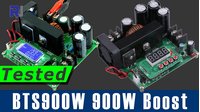
In this article, I’m going to share my hands-on testing experience with the JUNTEK BST-900W DC-DC boost converter, a module that is widely advertised as a 900-watt, 8-60V to 10-120V step-up converter. After purchasing and rigorously testing two units from the same brand, I discovered that this product falls dramatically short of its specifications, failing to deliver even a fraction of its claimed power output. This guide serves as a critical review and a warning for hobbyists and professionals alike, helping you avoid wasting your money on a component that simply does not work as advertised. The real-world value here is saving you from a costly mistake and showing you how to properly test a power converter to verify its true capabilities.
Here are a few practical scenarios where a genuine 900W boost converter would be essential, and where this module will inevitably fail:
- Powering high-wattage LED lighting arrays or electric motors in a robotics project that require a stable 80V or 120V rail.
- Creating a solar or battery backup system where you need to step up a 48V battery bank to a higher DC bus voltage for an inverter or industrial equipment.
- Building a benchtop power supply for testing high-voltage components, where consistent current delivery at the set voltage is critical.
- Upgrading an e-bike or electric scooter to a higher voltage motor controller, which demands a converter that can sustain high current without voltage sag.
Hardware Overview
The BST-900W module is marketed with an input range of 8 to 60 volts and an output range of 10 to 120 volts. The seller claims a maximum input and output current of 15 amperes. When you do the math (900W / 120V), this should yield a maximum output current of 7.5 amperes at the highest voltage setting. The module features a digital display for setting the output voltage and current, and it uses a large toroidal inductor and multiple capacitors to handle the supposed high power. In my testing, I purchased two units that appeared identical on the inside, despite having different display types (one LED, one LCD). This immediately suggested that the internal power stage was the same, and the only difference was the user interface.
Wiring Guide
Connecting the BST-900W is straightforward, but the results are disappointing. The module has clearly labeled input and output terminals. You connect your DC power source (8-60V) to the input side, and your load to the output side. In my test setup, I used a high-current 1500W bench power supply set to 50V with a 30A current limit to ensure the input was not the bottleneck. This was connected to the module's input via thick wires. The output was connected to an electronic load to precisely measure the voltage, current, and power. The wiring is simple, but as the testing shows, the module's internal circuitry is the limiting factor, not the external connections.
Code Explanation
There is no code involved in this project. The BST-900W is a standalone hardware module with a built-in microcontroller and display for setting parameters. It does not require any external programming or configuration via software. All adjustments are made through the buttons on the module itself.
Live Project: The Power Test
To demonstrate the module's failure, I conducted a series of controlled tests using a high-power bench supply and an electronic load. The goal was to see if the module could deliver its promised 900W, or even a fraction of that, at various output voltages. The results were consistently poor, showing that the module enters a constant-current protection mode far too early, collapsing the output voltage and limiting the total power to around 270-280 watts, regardless of the settings.
Test 1: 80V Output Target
I set the module's output to 80V and the current limit to 15A. Before turning on the load, the module displayed the set voltage. However, as soon as I applied a 5A load, the output voltage immediately dropped. The constant-current LED illuminated, indicating the module was limiting current. Instead of delivering 80V at 5A (400W), the output voltage sagged significantly, and the power reading on the load was only 273W. This proves the module cannot even sustain a 5A load at 80V, let alone the promised 11.12A (in video at 08:48).
Test 2: 120V Output Target
I then increased the target output to 120V with a 15A current limit. With the input supply providing 37.7V and a 5A load applied, the module again failed. The voltage dropped from the set 120V, and the power delivered was only 272W (in video at 09:46). This is a clear indication that the module is not a true boost converter capable of high-voltage, high-current output. The internal components and control algorithm are simply not designed for the advertised specifications.
Test 3: Input Power Verification
To rule out the possibility of an insufficient input supply, I verified my bench supply could deliver 1500W (50V at 30A). The module was connected to this robust source, yet it still failed to output the expected power. This confirms that the limitation is entirely within the BST-900W module itself (in video at 05:51). The module's "constant current" protection kicks in at a very low power threshold, preventing it from ever reaching its rated output.
In conclusion, the JUNTEK BST-900W is a misleading product. It is visually appealing and has a nice display, but its performance is a scam. It cannot deliver the advertised voltage or current, and it fails even under moderate loads. My advice is to avoid this module entirely and look for a reputable brand with verified performance data if you need a high-power DC-DC converter. Do not waste your money on this product.
Chapters
- [00:00] Introduction and Product Overview
- [00:37] Comparing Two Versions of the Module
- [02:00] AliExpress Listing and Specifications
- [03:35] Internal PCB Comparison
- [05:07] Setting Up the Test Bench
- [06:59] Testing at 80V Output
- [09:09] Testing at 120V Output
- [11:37] Final Verdict and Warning
Recursos e referências
Ainda não há recursos.
Arquivos📁
Nenhum arquivo disponível.