Ho to use TE3AC LiPo Battery Charger (Test and Review)
In this project guide, we dive into the TE3AC, a compact and versatile AC-powered balance charger designed for hobbyists and makers who work with 2-3 cell LiPo batteries or 1-8 cell NiMH battery packs. This review and test article will walk you through the charger's features, its operational workflow, and real-world performance metrics, helping you decide if it's the right power solution for your projects. Whether you're powering an RC car, a drone, or a custom robotics project, understanding how to safely and effectively charge your batteries is crucial.

The TE3AC charger is a great example of a practical, no-frills tool that simplifies battery management. Its value lies in its plug-and-play nature: you connect your battery, select the chemistry, and the charger handles the rest, including balancing individual cells. This is particularly important for LiPo batteries, where an imbalance between cells can lead to reduced performance or even dangerous swelling. The charger's built-in balance function ensures each cell is charged to the same voltage, prolonging battery life and ensuring safety.
Here are a few practical applications and project ideas where this charger would be an invaluable asset:
- RC Hobbyist Charging Station: Keep your 2S or 3S LiPo batteries for RC cars, boats, or planes topped up and balanced, ready for your next run.
- Drone Battery Maintenance: Ensure your drone's flight batteries are perfectly balanced for maximum flight time and stability.
- Robotics Power Management: For hobby robotics projects that use LiPo batteries, this charger provides a safe, dedicated charging solution outside of the robot's main power system.
- Portable Electronics Power Bank: Build custom battery packs for portable speakers or LED lighting systems and use the TE3AC to charge them safely.
- Educational Demonstrations: Use it to teach the principles of battery chemistry, charging cycles, and cell balancing in a classroom or workshop setting.
Hardware Overview
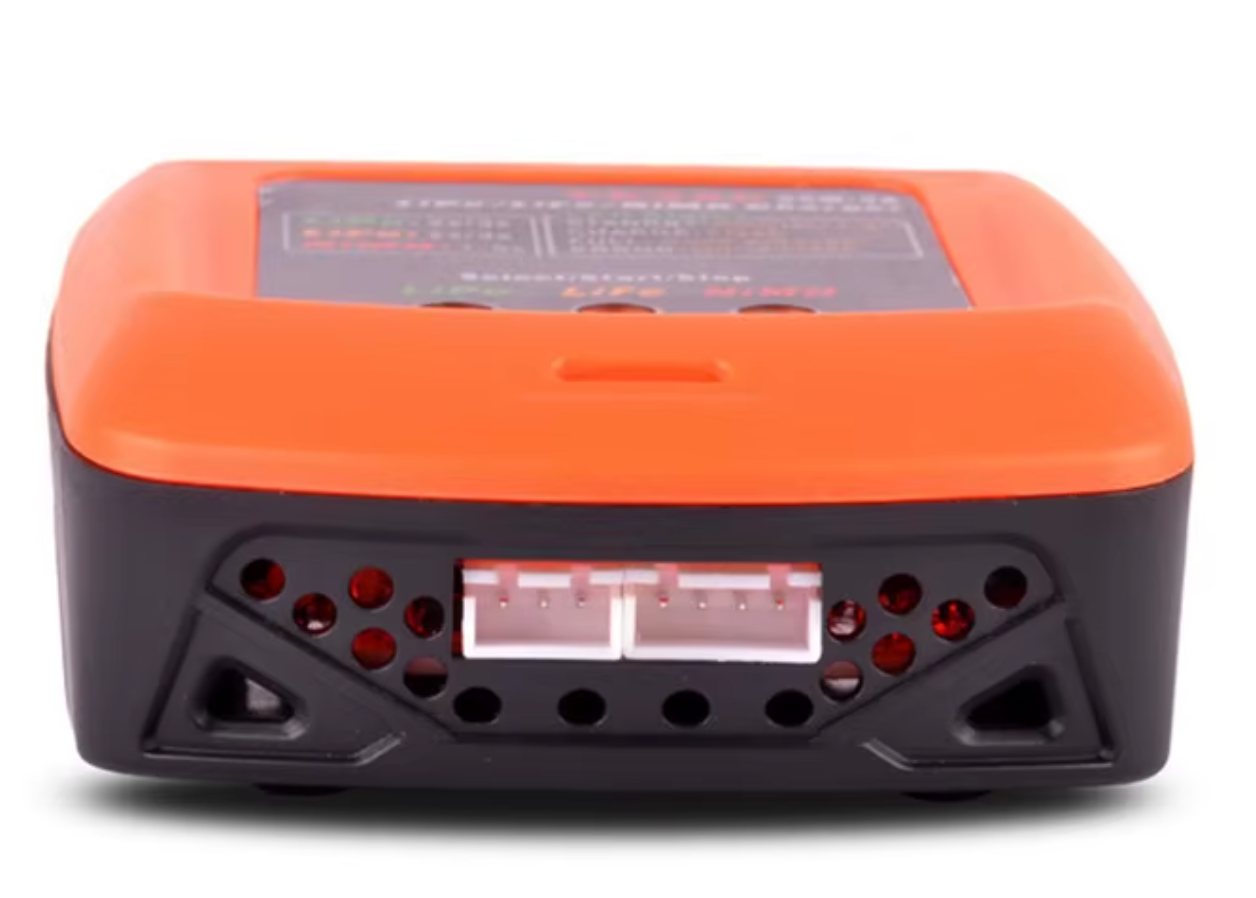
The TE3AC is a very straightforward device. Its front panel is minimal, featuring a standard AC power input for the included North American power cable. The charger is rated for worldwide use, accepting 100-240V AC. On the opposite side, you'll find two dedicated output connectors: a 2-cell (3-pin) and a 3-cell (4-pin) balance connector for LiPo batteries. The control interface consists of three buttons, each corresponding to a battery chemistry: Lithium Polymer (LiPo), Lithium Iron (LiFe), and Nickel Metal Hydride (NiMH). A set of three LEDs provides clear visual feedback on the charger's status.
In the box, you'll find the charger itself, the AC power cable, and a set of adapter cables including Tamiya and Dean (T) connectors for connecting to various battery types. A surprisingly decent English manual is also included, which is a welcome addition for clarity and safety. The charger's compact size is a major plus, making it easy to store in a toolbox or on a workbench. (in video at 01:03)
Wiring Guide
The wiring for this charger is refreshingly simple. There are no complex connections or external power supplies needed.

Here is the step-by-step process to connect your battery for charging:
- Connect AC Power: Plug the included AC power cable into the charger's input port and then into a wall outlet. The three LEDs will illuminate solidly, indicating the charger is in standby mode. (in video at 01:54)
- Connect the Battery: Identify the correct balance connector on your battery. For a 2-cell LiPo, use the 3-pin connector. For a 3-cell LiPo, use the 4-pin connector. Plug the battery's balance lead firmly into the corresponding port on the charger. When connected, all three LEDs will turn on again. (in video at 02:18)
- Select Battery Type: Press the button corresponding to your battery's chemistry. For a standard LiPo battery, press the "Lithium Polymer" button once. The LED for that chemistry will light up, indicating it's selected but not yet charging.
The charger also includes Tamiya and Dean (T) connector cables, which are often used for the main power leads of larger battery packs. To use these, you would connect the battery's main lead to the appropriate adapter cable, and then connect the adapter to the charger. However, for proper balancing, you must also connect the battery's balance lead to the charger's balance port.
Live Project: Testing and Demonstration
To test the charger's real-world performance, a 3-cell LiPo battery was used. The battery's initial voltage was measured at a low 10.9V, indicating it was significantly discharged and in need of a charge.
The charging process was initiated by connecting the battery and pressing the LiPo button twice. The first press selects the chemistry, and the second press starts the charging cycle. This is indicated by the selected LED beginning to blink slowly. The charger also has a safety feature: if the battery connection is lost during charging, the LED will blink rapidly to signal an error. (in video at 02:43)
During the test, the charging current was measured using a current clamp meter. The following observations were made:
- On the common wire, the current measured approximately 1.52A. (in video at 03:58)
- On another wire, it measured around 1.42A. (in video at 04:15)
- When measuring across all three wires, the current was approximately 1.7A. (in video at 04:25)
This test reveals a key performance metric: while the charger is rated for a maximum of 3A, the actual maximum charging current observed was 1.7A. This is a significant finding for users who expect the full 3A output. The charger will still effectively charge your batteries, but it will take longer than it would with a charger capable of delivering the full rated current. The charger will continue to charge until the battery is full, at which point the blinking LED will stop, signaling the completion of the charge cycle. (in video at 04:42)
Conclusion
The TE3AC is a solid, compact, and easy-to-use balance charger that is perfect for beginners and hobbyists. Its simple button-and-LED interface makes it incredibly intuitive, and the inclusion of a balance function ensures your LiPo batteries are charged safely and evenly. The main caveat is its real-world charging current, which peaked at 1.7A in our tests, well below the advertised 3A maximum. This means longer charge times, but for many users, the convenience and safety features may outweigh this limitation.
Chapters
- [00:06] Introduction and Unboxing
- [01:27] Charger Overview and Controls
- [02:00] Connecting and Starting the Charge
- [03:18] Measuring the Charging Current
- [04:53] Conclusion and Final Thoughts
Images
Ce dont vous pourriez avoir besoin
-
Amazon
-
AliExpressBuy TE3AC battery charger from AliExpresss.click.aliexpress.com
Ressources et références
Aucune ressource pour le moment.
Fichiers📁
Aucun fichier disponible.