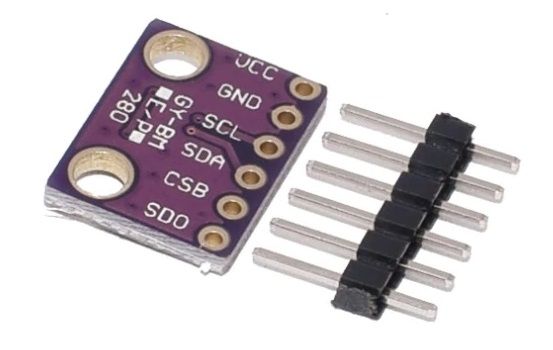
ME-BME280 is a Breakout Board featuring a Bosch Sensortec BMP280 Temperature, Humidity & Pressure Sensor.
The board has a selectable I2C address jumper (solder link GS2), I2C pull-up resistors, a 7-pin 2.54mm header, and two 3.5mm mounting holes.
Default settings for the board include: a single power rail Vdd=Vdd_IO (solder link GS1), 10k pull-up resistors (R2, R3), a 0-ohm protocol selector resistor (R1), and 0.1uF decoupling capacitors on both power supply pins Vdd & Vdd_IO.
If you connect the board to both power rails VDD_IO 1.8V and VDD 3.3V, be sure to remove the power rail jumper GS1!
BME280 Features
- Package: 2.5 mm x 2.5 mm x 0.93 mm metal lid LGA
- Digital interface: I2C (up to 3.4 MHz) and SPI (3 and 4 wire, up to 10 MHz)
- Supply voltage: VDD main supply voltage range: 1.71 V to 3.6 V
VDDIO interface voltage range: 1.2 V to 3.6 V
- Current consumption: 1.8 uA @ 1 Hz humidity and temperature
2.8 uA @ 1 Hz pressure and temperature
3.6 uA @ 1 Hz humidity, pressure and temperature
0.1 uA in sleep mode
- Operating range: -40…+85°C, 0…100 % relative humidity, 300…1100 hPa. Humidity and pressure sensors can be independently enabled/disabled.
Bosch has stepped up its game with its new BMP280 sensor, an environmental sensor with temperature and barometric pressure that is the next-generation upgrade to the BMP085/BMP180/BMP183. This sensor is great for all sorts of weather sensing and can even be used with both I2C and SPI!
This precision sensor from Bosch is the best low-cost, precision sensing solution for measuring barometric pressure with ±1 hPa absolute accuracy, and temperature with ±1.0°C accuracy. Because pressure changes with altitude, and the pressure measurements are so good, you can also use it as an altimeter with ±1 meter accuracy.
The BME280 is the next-generation of sensors from Bosch, and is the upgrade to the BMP085/BMP180/BMP183—with low altitude noise of 0.25m and the same fast conversion time. It has the same specifications but can use either I2C or SPI. For simple, easy wiring, go with I2C. If you want to connect a bunch of sensors without worrying about I2C address collisions, go with SPI.
Resources & references
No resources yet.
Files📁
No files available.